Tuesday, July 28, 2020

Orchard Days - Part 1 (Planting)


We live on a fruit farm. The official name of the farm/business is Martin's Family Fruit Farm. We grow and pack apples. Our house and yard are surrounded by many apple trees as well as orchard equipment and buildings. The above photo is my view from our back deck in springtime. I love watching the orchard scenes change with the coming and going of different seasons. 

Ken does most of his work as a fruit farmer in several orchards that Martin's owns but are not in our local vicinity. Those orchards are in Vienna, Ontario, near Port Burwell on the shores of Lake Erie, so Ken drives an hour and a quarter to work every weekday. He supervises our crews of offshore workers in their various responsibilities that come with maintaining apple orchards throughout an entire growing season.

Once in awhile, I ride along with Ken when he goes to Vienna. I'm intrigued with the orchard goings-on, and it seems like every time I observe the orchard scene, I learn something new about growing apples. I've gone with Ken to Vienna twice this year so far, both times on a Saturday in the spring. On both trips, I took my camera with me and tried to capture in photos some of the workings of our orchards.

I plan to publish a little series of blog posts about what I've seen and learned on Orchard Days throughout the apple season this year. The pictures I include will be from both the Vienna farms and the orchards in the area where we live. This first post in the series is about planting apple trees - one of the earliest jobs to do in the spring on an apple farm.


Fruit farmers don't do new plantings every year, but when they do, they need to prepare the field or acreage for the new trees. This preparation often begins with removing the old trees that are well beyond producing their best crops. Apple trees age and decline in production until it is no longer wise and efficient to keep harvesting their fruit. I always feel a twinge of sadness when I see piles of dead  trees in an orchard. I know that the old needs to be uprooted so that the new has opportunity to take root, but that knowledge doesn't entirely remove my lament. The bare orchard often lies fallow for at least a year before the new planting. Perhaps it has its own season of silent grief before picking up and moving on to new and beautiful growth.


Martin's buys the majority of their young apple trees from a nursery. The individual trees are in their second year of existence by the time they come to the field for planting. The young apple saplings appear to be individual branches simply stuck in the ground at intervals. These thin, leafless "twigs" are called whips, because that is exactly what they look like. 


The whips with roots usually come in bundles of ten. A skid loader brings the rack of bundles to the field where the trees can easily be loaded on to the tree planter pulled behind a tractor.


Workers need to cut the ties that bind the bundles, for easier access to the tree whips for planting.


Here a crew of around twenty workers perform the planting operation. A GPS guides the tractor and planter over the field, marking the rows with precision. 
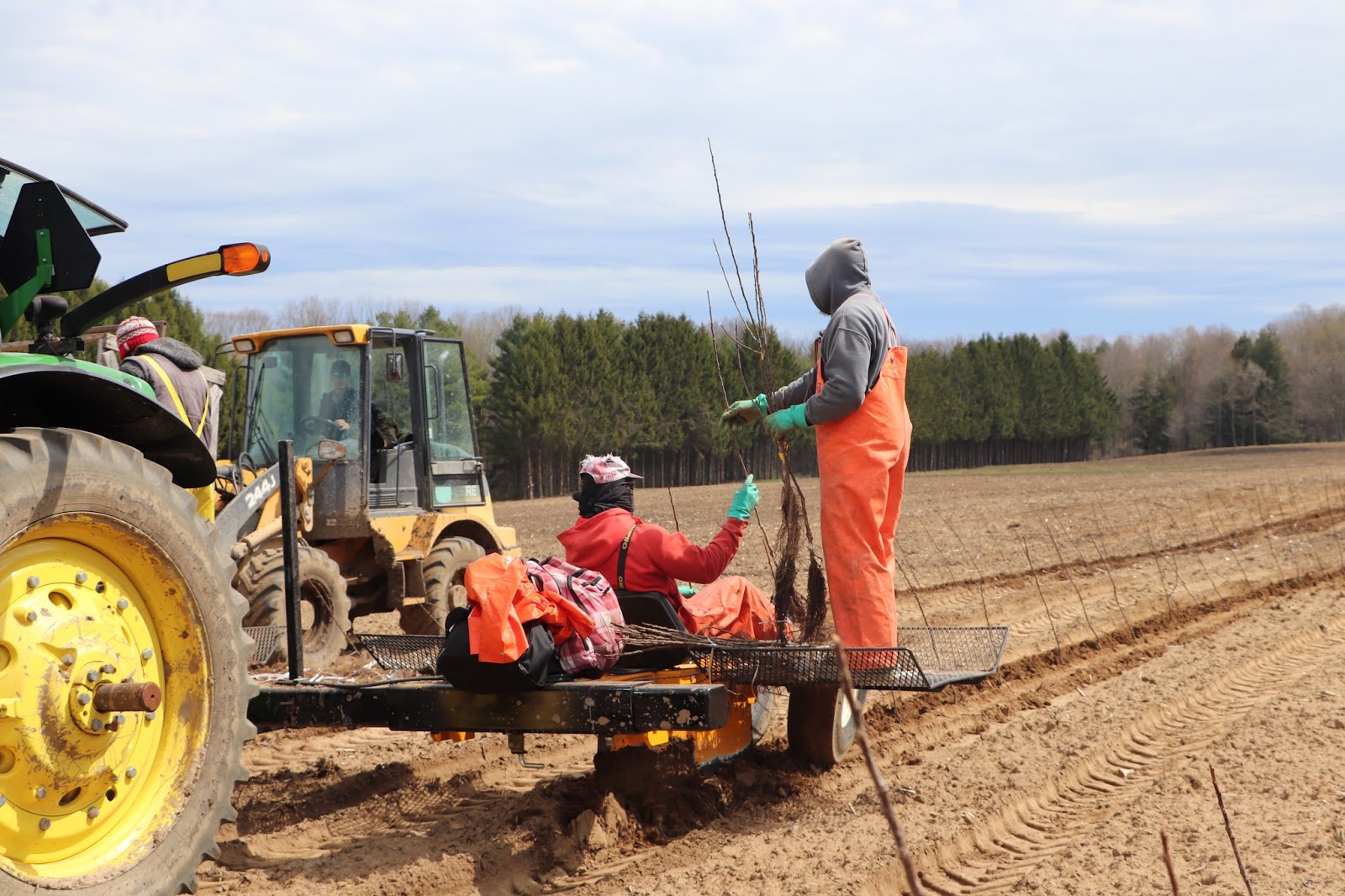


Four men work on the two-row planter. One man in each pair stands on the planter and hands the whips to the one seated who feeds the young trees into the planting mechanism.


The planter sets the whips into a groove in the soil; I guess one could say it plants the trees after a slanting fashion. Each sapling need to be situated into an upright position and the soil needs to be tamped firmly around its thin trunk. 


This "uprighting" and tamping is done by hand (and foot) as the planting crew members traipse along behind the tractor and planter. Shovels and boots are tools that assist. 


After Ken finished coaching the workers in the field that day, we drove to Martins' large apple storage facility. I saw the rows and rows of empty bins stacked there, and thought about what all needs to happen in the orchards during the months (and years!) between planting trees and filling those bins at harvest time. My appreciation goes to all the workers who will make it possible.


There's nothing quite like a crisp Ambrosia apple for a snack. I surely am grateful that somebody once planted some apple trees! 

Note: Ken is the apple expert around here. I will definitely be asking him to look over these blog posts for accuracy before I publish them! You may get a taste of his knowledge and expertise in orchard management by listening to him speak on Everyday Expertise, a podcast our son Rolin recently created. 


Sunday, July 12, 2020

Walking Into the Sunset


According to Idioms by The Free Dictionary, the term "riding into the sunset" means "To resolve or conclude things in a neat, happy, and satisfactory fashion; to retire from work, use, or relevance, especially on a positive note or after a long and successful period of activity." When I read that definition, I thought how nice it would be if COVID Life would ride off into the sunset for once. I refer to the ending in a neat and happy fashion, and the part about retiring after a long period of activity, not so much the word "successful". 

If there will be anything to be described as successful about this time, perhaps it will have to do with lessons we've learned, the new perspectives we've gained. I'm convinced that, for me, the good memories of this time will include a more relaxed schedule, more time bonding with family and friends, and more moments observing nature.

One of my activities during COVID involving all three of those memories is walking. I don't walk nearly as often as Ken does (he's up to a 16,000+ steps daily goal!) but I walk several times a week, most often in the evenings. I usually walk with Ken or Kerra, or both, and sometimes with a friend. I love seeing beauty in nature as I walk. Once in a while I take my camera along, and photograph some of that beauty. It slows down the walking, for sure, but it speeds up my enjoyment of the activity.

I notice the variety in clouds - from great hulking masses that backdrop a whole set of farm and town buildings...


...to the horsetails wispy-swishing across the blue yonder.


Flowers take my eye - the dainty elegance of Queen Anne's Lace...


...the milkweed's purple burst of fireworks... 


...and the spiky teasel spearing the evening sky. 


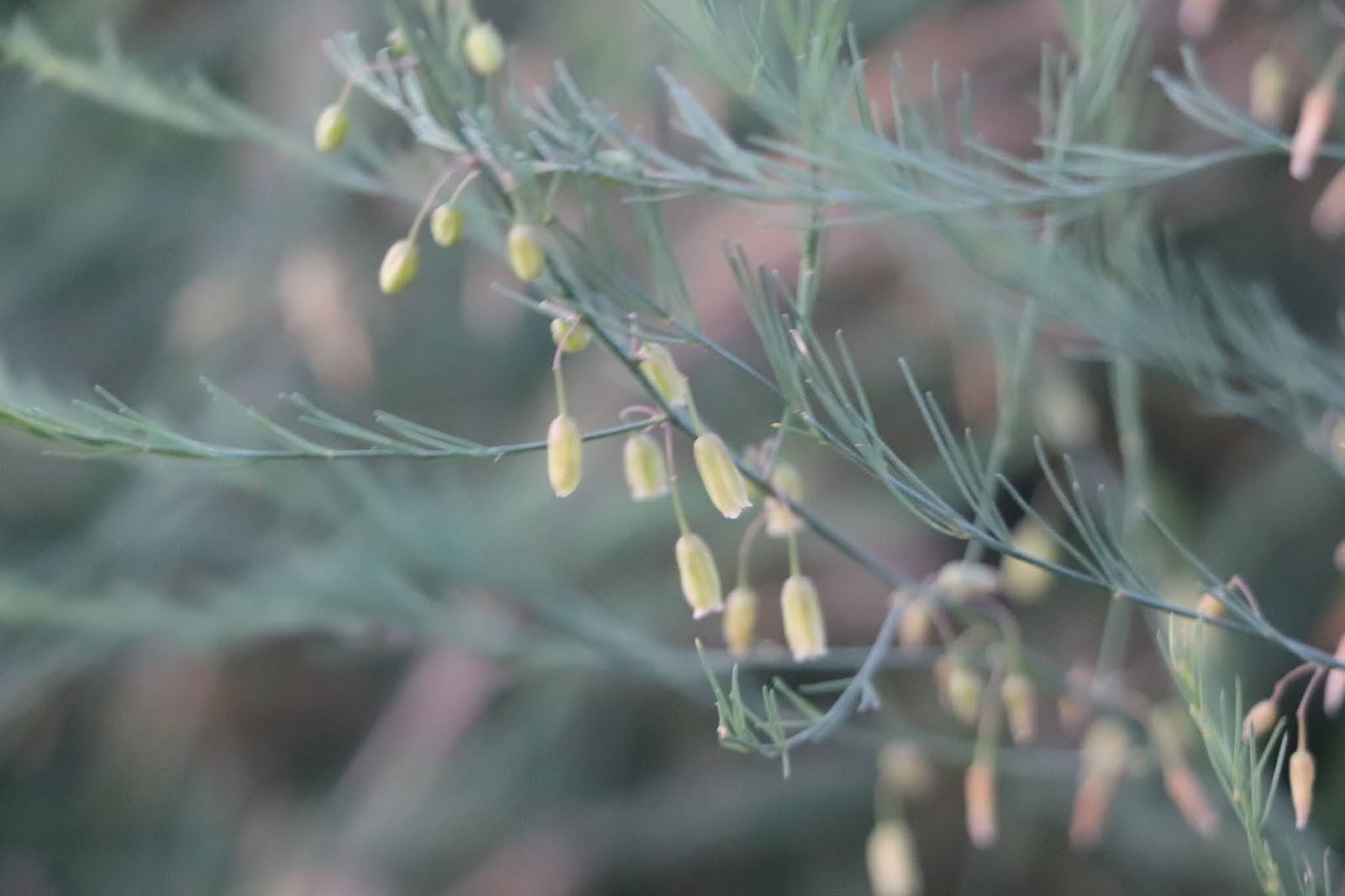
And who knew that going-to-seed wild asparagus in the ditch has tiny yellow bells along its ferny fronds?


I take note of all the rabbits. There are many. I call them names like Fiver and Bigwig and wonder about their secret life, especially since reading Watership Down, our first book in the Book Club for we3@home this summer.


I marvel at the way God enhances ordinary scenes of grasses, weeds, and leaves by placing a setting sun behind them.  


"Walking into the sunset." I can't think of a much better term for describing the event of strolling along our road with Ken on a summer evening, sometimes hand in hand, "retiring from work, especially on a positive note, in a neat, happy, and satisfactory fashion." I call that "successful" for making good memories. Thanks, COVID.

                         Photo cred: Kerra Martin

Saturday, June 20, 2020

Reaching the Speed Limit


Call it the Speed Limit Birthday or the Double Nickel Birthday, it happened to me last week. Yes, I turned 55 on "a sunny day in June" which, I am told, is also the description for the day I arrived twenty-some minutes after my twin sister all those years ago.

This year, my birthday had an unprecedented feature (unprecedented - why did I use that tired word?), falling as it did during what we hope is the latter days of COVID-19. This is the first time I've had a birthday during a worldwide pandemic. (Try that phrase on for redundundancy) I really
think that made a difference in the celebration.

                         Photo Cred: Ken Martin

For one thing, it made our family's being able to gather seem more precious. Sadly, not all of the Kenites could be present for our Sunday lunch on the patio and afternoon of games and conversation since Joy, the nurse in the family, was on a work shift, and since the US-Can border closure prevented Carlin & Kayleen from joining us. But it was lovely to be far enough out of lockdown and into Phase Two of Reopening to be legal in our congregating. In Ontario the regulation has advanced to allowing people to meet in groups of 10 or less. And there's something about creating a bubble of people inside which we do not have to continue the physical or social distancing practice. Yay, bring on the holding the grandson once again!


Ken and Kerra planned an excellent birthday lunch of burgers and salads. The meal ended with two birthday cakes! I'm sure it was more because of the desire for cake AND ice cream (one was an ice cream cake) than one for each 5 in my age. We played Bocce on the lawn in the afternoon and watched Seth motor around the vast grassy area in his unique scoot-crawl maneuver. Next thing you know, we thought, he'll be toddling over the lawn instead of crawling. And sure enough, he DID start walking on his own a few days later.


Another thing that made my birthday-during-pandemic different than usual was that I received multiples of things. Such as parties and surprises. Phone calls and messages. Flowers and cakes. Instead of describing each in detail, I will post a few pics that I took to document some of the multiples, and you may ask me about anything you'd like to know more about.


                             Photo Cred: Kerra Martin


Lastly, I think more people than usual remembered my birthday since it happened during COVID. Do people have more time in general, giving them extra mental and heart space to think of others? Are people more intentional to do their part to counter loneliness during this time? I don't know all the reasons behind it, but I do know that I soaked it up.


I felt so blessed and affirmed and rich.

Fifty-five. If you go by what used to be the miles-per-hour speed limit on the main roads in Wisconsin when I was growing up, I've reached the speed limit in age. It would be nice to think that now life will slow down, having reached its limit in speed, and I can sort of coast from here on out. I'm guessing, though, my own energy and intellect will be what seems limited at times. I know this will call for even greater dependence on the Limitless One.

Recently my daughter Kerra asked me what makes me most excited about being 55, and my answer was "learning more about who God is and experiencing more of the richness of being His daughter." I have a feeling that making these discoveries will keep me occupied for a lifetime because my Father's love has no limit. 


Monday, May 11, 2020

Three Ideas on Mother's Day


There are so many things I could put into a blog post for Mother's Day. Memories of Mom-Eva, thoughts of love and gratitude for Mom-Ruthie (the best second mom ever) and Mom Martin (the best mom-in-law ever), funny sayings and exasperating moments arising from life with my offspring back when I was a young mother, lovely ways that my now-adult children are rising up and calling me blessed...you get the picture.


                               Photo Credit: Ken Martin


While there is certainly ample fodder for all those things, I'm not going there in this post. I've decided instead to share a few things a mother or a teacher (or, really, anyone who influences young people in some way) can impart to children.

Among the habits and abilities one could pass along to children, there are certain skills that I think are beneficial for any young person to carry with them into adulthood - handy tools to pull out of one's carpenter apron in life, as it were. Here are three of them:

Skill #1. How to begin and maintain good conversation.
As an adult, one will likely encounter many situations in which steady and meaningful conversation is welcomed, if for nothing else but to override swallowing noises of guests at a Sunday dinner table, as my mom used to say. It can be of great benefit to have two or three conversation starters to pull out of one's bag to get things started. And just a hint on that - something I heard a long time ago and makes total sense to me: It is better to ask someone what they like about a thing, rather than if they like a certain object or situation. You'll be able to maintain a conversation much longer, for instance, if you ask a scholar "What do you like about school?" rather than "Do you like school?" Or, more appropriately for the season: "What do you like about your mother?" instead of "Do you like your mother?"


Skill #2. Knowing what to do when you're bored.
The current lockdown aspect of the COVID-19 pandemic has likely brought out the boredom feature of everyday life in many a household. What better time is there than now for honing the skill of coping or even thriving when bored? "Go read", "Here, I'll give you a chore to do", "Let's play a guessing game" were some of my mom's responses when I or one of my siblings posed the question of "I'm bored - what can I dooooo?" These suggestions join a host of possible ways to occupy one's body and mind in a meaningful way during a time of potential drudge and laziness. Learning to recognize the onset of boredom and knowing how to implement such boredom busters as reading, doing crafts, working on a project, engaging in hobbies, playing board games, writing, doing jigsaw puzzles, etc. is a skill worth developing. And, if all else fails, one can always resort to playing with words!


Skill #3. The habit of writing things down.
There are ever so many good uses for knowing how to process, clarify, record, document and remember something by writing it down. The older we grow, the more we realize that we will tend to forget the details of life happenings if we don't write them down as soon as possible after they happen. Journaling is a great way to practice this skill and one can begin it already at a young age. Making lists, using a planner, taking notes, and recording data are other great habits to develop along the writing lines. My sisters and I used to chuckle at our mom's propensity for splashing the name and date in magic marker seemingly on every gift or item she purchased, but now we find ourselves doing similarly. Is this for nostalgia's sake, or did her writing habits rub off on us? Even though she's been gone 25 years now, I keep thinking of things she taught me that I want to always remember, and to pass on to my children. Perhaps I'd better go write them down!


Are there things you would add to this list? What do you consider essential skills to pass on to the younger people in your life?